

Editor’s note: Last month, I attended Future Summit, an annual conference of Future Caucus’s bipartisan group of state legislators. I don’t always get the chance to chat with elected officials (let alone ones who happen to be my age), so I was curious to hear what was on their minds.
The refrain I heard over and over — from Democrats and Republicans, men and women — was, “I work three jobs to make this work.” That’s crazy! And, as Arianna Conte and Steph Scaglia of RepresentWomen write, it’s solvable.
The decision to run for state legislature is not easy — especially for women. Complicating factors like finding childcare, managing unpredictable hours, balancing time commitments, weighing concerns about physical and emotional safety, and more are all top of mind for women looking to take public office across the party spectrum. Serving your community as an elected official is a permanent lifestyle change, regardless of whether the legislature is part-time or full-time.
Another complicating factor for women running for office is low state legislator salaries, which vary nationwide. For example, California pays its state legislators $140,000, while New Mexico doesn’t pay a standard salary at all, only per diems. In 18 states, legislators can’t get a pay increase without passing a bill or asking voters to sign a ballot measure approving an increase. Even worse, pay adjustments often don’t occur regularly, meaning they rarely account for factors such as inflation or public health emergencies like the COVID-19 pandemic.
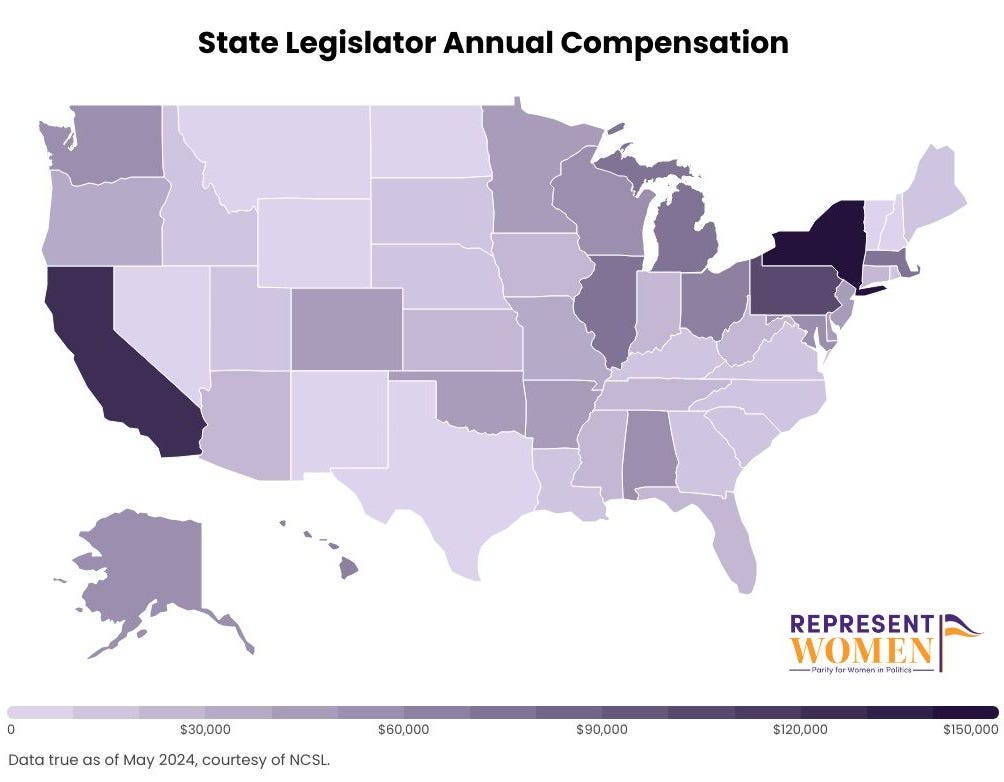
The “perennial pay problem,” as we call it in “Salaries of State: Modernizing State Legislatures through Compensation Commissions,” determines who runs for and stays in office. The pay problem is by no means new, but what’s clear is the financial cost of becoming an elected official is exponentially more challenging for women. Women are over half the population but only 33% of state legislators, and routinely consider salary when deciding whether to run for office or reelection.
Salaries of State shows that to remedy the perennial pay problem, we must implement systems-level reforms to ensure a robust pipeline of women can run for office at all levels of government. Establishing compensation commissions, which regularly examine and adjust state legislator wages, is a viable option to level the playing field for women. Compensation commissions are already used in 22 states and have widespread voter approval. This popularity is unsurprising as they remove voter and legislator bias from the process.
It’s no secret that legislators, regardless of gender, need to be paid more. Moreover, fair pay for legislators is essential in getting more women to run for office. Systems-wide solutions like compensation commissions can eliminate the perennial pay problem and enable women to serve in office sustainably.
Arianna Conte is a Communications Manager at RepresentWomen.
Steph Scaglia is Research Manager, US Rules and Systems at RepresentWomen.
You can submit a pitch to Democracy Takes here.